




Blog Summary: Heart-healthy eating can also protect your teeth and gums. Nutrient-dense foods like lean proteins rich in arginine, crunchy vegetables, leafy greens, fatty fish, and unsweetened tea support oral health while promoting cardiovascular wellness. A balanced, whole-food diet helps reduce inflammation and biofilm—but should complement, not replace, professional dental and medical care.
Heart-healthy eating has been recommended for decades. The good news: many heart-smart foods also support your teeth and gums. As a dentist, I think about nutrition through two lenses–inflammation and biofilm–because both affect oral and cardiovascular health.
Here are five nutrient-dense foods that pull double duty for the health of your heart and mouth:
AIM FOR ARGININE. Found in turkey, chicken, soybeans, chickpeas, peanuts (avoid if allergic), and other legumes.1 Emerging research suggests salivary arginine may support a healthier oral environment and may complement fluoride’s remineralization benefits, helping reduce cavity risk.2 Lean proteins like poultry are generally better for heart health than many higher-saturated fat cuts of beef or pork. Some research also suggests arginine may support vascular function and inflammation balance.3
GET CRUNCHY. Crunchy vegetables like carrots, broccoli, and cauliflower help stimulate your gums and boost saliva, which naturally helps rinse away food particles. They don’t replace brushing, but they’re a great way to support oral health, says Deepika Dhama, DDS. Additionally, celery and carrots are rich in beta carotene, which your body converts into vitamin A–essential for maintaining healthy oral tissues.4 Higher-fiber, plant-forward eating patterns are also associated with healthier LDL (“bad”) cholesterol in some studies.5
Higher-fiber, plant-forward eating patterns are also associated with healthier LDL (“bad”) cholesterol in some studies.
FAVOR FISH. Fatty fish like salmon provide omega-3s and can be a source of vitamin D, which supports calcium absorption for strong teeth and bones. Omega-3s are best supported for lowering triglycerides; effects on LDL/total cholesterol can vary.7
BREW SOME TEA. A 2025 Frontiers in Nutrition review suggests tea contains compounds that may support cardiovascular health (lipids, blood pressure, antioxidant/anti-inflammatory effects), though results vary by tea type, dose, and study design.8 “Unsweetened green or black tea has polyphenols that can help fight bacteria in the mouth,” says Christopher Tolmie, DDS, MBA, a multi-practice dentist in Florida.
Note: Nutrition supports oral health and heart health, but it doesn’t replace dental care or individualized medical guidance. The real win is consistency
In January, the U.S. government introduced updated dietary guidelines with a focus on nutrient-dense, whole foods and reducing processed options. Below is the New Pyramid. Talk to your doctor or nutritionist about healthy eating that’s right for you.
The New Pyramid: Guidelines for Healthy Eating
In January, the U.S. government introduced updated dietary guidelines with a focus on nutrient-dense, whole foods and reducing processed options. Below is the New Pyramid. Talk to your doctor or nutritionist about healthy eating that’s right for you
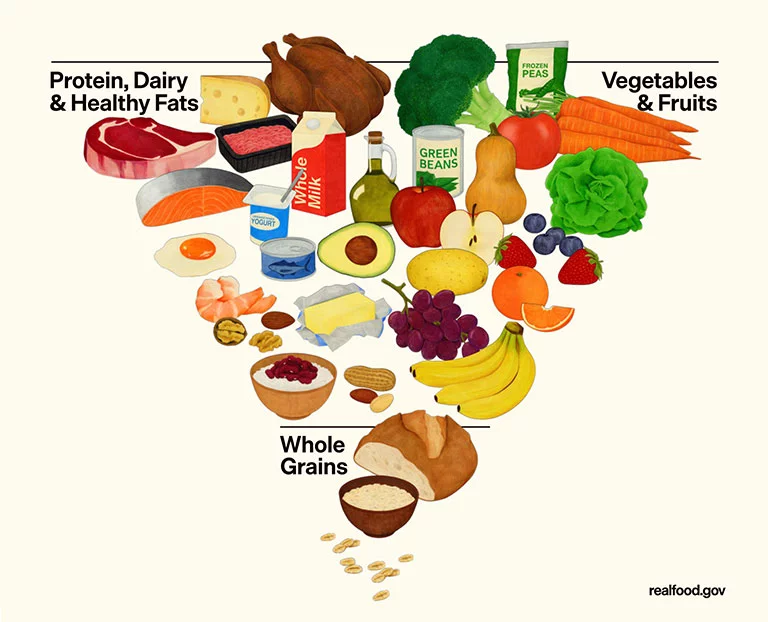
Protein
Choose high-quality protein from animal and plant sources–eggs, poultry, seafood, red meat, lentils, legumes, nuts, seeds, and soy. Target: 1.2-1.6g per kg of body weight daily.
Vegetables & Fruits
Fill your plate with whole, colorful vegetables and fruits in their natural form. Target: 3 servings of vegetables and 2 servings of fruits daily.
Whole Grains
Prioritize fiber-rich whole grains over highly processed carbs that displace real nourishment. Target: 2-4 servings daily.
Healthy Fats
Incorporate wholefood fats like meats, poultry, eggs, omega-3-rich seafood, nuts, seeds, full-fat dairy, olives, and avocados. Limit saturated fats to 10% of daily calories.
Hydration
Drink water and unsweetened beverages throughout the day.
Alcohol
Consume less alcohol for better overall health.
Added Sugars & Processed Foods
Minimize processed foods, refined carbs, and added sugars. Choose naturally occurring sugars from whole fruits and dairy. Target: No more than 10% of daily calories from added sugars.
Ultimately, everyone’s needs are different. How much you eat depends on your age, sex, height, weight, and activity level, so be mindful of portions, particularly when it comes to higher-calorie foods and drinks. You can learn more by reviewing the current federal dietary guidelines.
Find your trusted, local dentist today!
Sources
[1] Oral Health and Nutrition, Health Resources and Services Administration (https://www.hrsa.gov/oral-health/nutrition)
[2] “Arginine: A New Paradigm in Preventive Oral Care,” International Journal of Clinical Pediatric Dentistry, Sept.-Oct. 2023 https://pmc.ncbi.nlm.nih.gov/articles/PMC10753110/
[3] “L-Arginine Enhances the Effects of Cardiac Rehabilitation on Physical Performance: New Insights for Managing Cardiovascular Patients During the COVID-19 Pandemic,” The Journal of Pharmacology and Experimental Therapeutics https://pmc.ncbi.nlm.nih.gov/articles/PMC9190231/
[4] Eat Fruits and Veggies For A Healthy Smile, University of Illinois Chicago School of Dentistry https://dentistry.uic.edu/news-stories/eat-fruits-and-veggies-for-a-healthy-smile/
[5] Effectiveness of High-Fiber, Plant-Based Diets in Reducing Cardiovascular Risk Factors Among Middle-Aged and Older Adults: A Systematic Review,” Cureus, Aug. 24, 2024 https://pmc.ncbi.nlm.nih.gov/articles/PMC11419598/
[6] “Crucial Facts About Health Benefits Of Popular Cruciferous Vegetables,” Journal of Functional Foods, January 2012 https://www.sciencedirect.com/science/article/pii/S1756464611000843
[7] “Association of dietary omega-3 fatty acids intake with all-cause and cardiovascular disease-specific mortality among individuals with cardiovascular disease,” Nature: Scientific Reports, October 24, 2025 https://www.nature.com/articles/s41598-025-21193-1#:~:text=In%20summary%2C%20our%20research%20indicates,for%20ALA%20for%20CVD%20patients.
[8] “The role of tea in managing cardiovascular risk factors: potential benefits, mechanisms, and interventional strategies,” Frontiers in Nutrition, Apr. 24, 2025 https://pmc.ncbi.nlm.nih.gov/articles/PMC12058793/
Smile Generation blog articles are reviewed by a licensed medical professional prior to publishing. The information provided is for educational purposes only and is intended to support readers’ understanding of health and wellness. This content is not meant to replace professional medical advice, diagnosis, or treatment provided by a healthcare professional. We always recommend seeking the advice of a qualified healthcare provider with any questions regarding a medical condition or treatment.